Abstract
The search for effective and environmentally sustainable bioherbicides is a key objective in integrated weed management. This study evaluated the herbicidal potential of bergamot (Citrus bergamia) juice, a by-product of the essential oil industry, based on its high acetic acid content. Field experiments were conducted using a randomized complete block design to test five application rates (1,500, 1,200, 900, 600, and 300 L ha-1) on two contrasting weed communities: young regrowth (one week after mowing) and established weeds (four months after mowing). Efficacy was assessed over 60 days using the Henderson-Tilton formula and the European Weed Research Council (EWRC) rating scale. Soil pH was analyzed post-trial to detect acidification. A central finding was the stark contrast in efficacy based on weed growth stage. On established weeds, the rates of 1,500 L ha-1 and 900 L ha-1 provided the best control, with a residual activity of 30-45 days and efficacy >90% for up to 45 Days After Application (DAA). In sharp contrast, the treatment was largely ineffective on young regrowth, with even the highest doses providing only transient control that declined to very poor efficacy (≤31%) by 60 DAA. Results demonstrated that bergamot juice provided effective control of a broad spectrum of broadleaf weeds, including Phyllanthus amarus and Ageratum conyzoides, but showed poor efficacy against several grass species, particularly Paspalum dilatatum. Critically, no significant or consistent changes in soil pH were detected following application. The findings confirm that bergamot juice is a viable contact bioherbicide for managing established broadleaf weeds without impacting soil acidity but is not suitable for controlling young regrowth. Further research is needed to optimize application strategies, determine its economic feasibility, and fully elucidate its efficacy spectrum for commercial adoption.
Keywords
Citrus bergamia, Organic Weed Control, Acetic Acid, Contact Herbicide, Non-target Effect, Sustainable Agriculture
1. Introduction
Weeds are a principal biotic constraint in agricultural systems, significantly threatening global food security by reducing crop yield and quality
. They compete with crops for essential resources—including light, water, and nutrients—at all stages of development
| [2] | Zimdahl, R. L. (2018) Fundamentals of Weed Science. Academic Press. |
[2]
. Beyond resource competition, weeds can serve as alternate hosts for pests and pathogens and exhibit allelopathic effects that suppress crop growth
| [3] | Jabran, K. (2017) Allelopathy: Introduction and Concepts. In: Jabran K, editor. Manipulation of Allelopathic Crops for Weed Control, Springer International Publishing, Cham. p. 1–12.
https://doi.org/10.1007/978-3-319-53186-1_1 |
[3]
. In sub-Saharan Africa, yield losses attributable to weeds are particularly acute, with estimates ranging from 10% to over 50%, depending on the crop and local conditions
| [4] | Rodenburg, J., Büchi, L. and Haggar, J. (2021) Adoption by adaptation: moving from Conservation Agriculture to conservation practices. International Journal of Agricultural Sustainability, 19, 437–55.
https://doi.org/10.1080/14735903.2020.1785734 |
[4]
.
Chemical control with synthetic herbicides has been a cornerstone of modern weed management due to its high efficacy, cost-effectiveness, and labor-saving benefits
| [5] | Gianessi, L. P. (2013) The increasing importance of herbicides in worldwide crop production. Pest Management Science, 69, 1099–105. https://doi.org/10.1002/ps.3598 |
[5]
. However, heavy reliance on these chemicals has led to well-documented drawbacks, including the evolution of herbicide-resistant weed populations and negative impacts on environmental and soil health
| [6] | Powles, S. B. and Yu, Q. (2010) Evolution in action: plants resistant to herbicides. Annual Review of Plant Biology, 61, 317–47. https://doi.org/10.1146/annurev-arplant-042809-112119 |
| [7] | Silva, V., Mol, H. G. J., Zomer, P., Tienstra, M., Ritsema, C. J. and Geissen, V. (2019) Pesticide residues in European agricultural soils – A hidden reality unfolded. Science of The Total Environment, 653, 1532–45.
https://doi.org/10.1016/j.scitotenv.2018.10.441 |
[6, 7]
. These concerns have intensified the search for sustainable, integrated weed management tools, particularly within the framework of organic agriculture.
Bioherbicides, derived from natural sources such as microorganisms
| [8] | Kremer, R. J. and Kennedy, A. C. (1996) Rhizobacteria as Biocontrol Agents of Weeds. Weed Technology, 10, 601–9.
https://doi.org/10.1017/S0890037X00040525 |
| [9] | Mathur, M. and Gehlot, P. (2018) Recruit the Plant Pathogen for Weed Management: Bioherbicide – A Sustainable Strategy. In: Gehlot P, and Singh J, editors. Fungi and Their Role in Sustainable Development: Current Perspectives, Springer, Singapore. p. 159–81.
https://doi.org/10.1007/978-981-13-0393-7_10 |
[8, 9]
or plant extracts, offer a promising alternative with a potentially more favorable environmental profile
| [10] | Cordeau, S., Triolet, M., Wayman, S., Steinberg, C. and Guillemin, J.-P. (2016) Bioherbicides: Dead in the water? A review of the existing products for integrated weed management. Crop Protection, 87, 44–9.
https://doi.org/10.1016/j.cropro.2016.04.016 |
[10]
. The global portfolio of registered bioherbicides, though small, is growing, with products based on fungi, bacteria, and phytotoxic plant compounds
| [11] | Kudsk, P. and Mathiassen, S. K. (2004) Joint action of amino acid biosynthesis-inhibiting herbicides. Weed Research, 44, 313–22. https://doi.org/10.1111/j.1365-3180.2004.00405.x |
| [15] | Win, P.-P., Park, H.-H., Kuk, Y.-I., Win, P.-P., Park, H.-H. and Kuk, Y.-I. (2023) Control Efficacy of Natural Products on Broadleaf and Grass Weeds Using Various Application Methods. Agronomy, 13.
https://doi.org/10.3390/agronomy13092262 |
[11–15]
. Among natural herbicidal compounds, organic acids have demonstrated significant potential. Acetic acid, for instance, has been proven effective as a non-selective, contact bioherbicide, causing desiccation and plant death by disrupting cellular membranes
.
Other acids, such as pelargonic acid, are also commercially used as natural herbicides, sharing this rapid contact action. Bergamot (Citrus bergamia Risso & Poiteau) is a citrus fruit whose industrial processing for essential oil from the peel generates large quantities of juice as a by-product. Similar to vinegar, bergamot juice contains organic acids, including acetic acid, suggesting its potential utility as a natural herbicide within this class of compounds. Preliminary, unpublished field observations indicated that applications of bergamot juice could achieve complete weed control in small plots, warranting a systematic investigation into its efficacy.
This study was therefore conducted to evaluate the bioherbicidal potential of bergamot juice scientifically. The specific objectives were to: (i) determine the application rate that provides the highest weed mortality; (ii) define its efficacy spectrum and identify resistant weed species; (iii) establish its residual activity in the field; and (iv) assess its impact on soil acidity.
2. Materials and Methods
2.1. Study Field: Climatic and Edaphic Characteristics
The field experiment was conducted during the primary rainy season, from February to April 2024. Climatic data, including precipitation, air temperature, and relative humidity, were recorded on-site using a standard rain gauge and a Vantage Vue weather station (Davis Instruments, Hayward, CA, USA). The monthly averages for these parameters are summarized in
Table 1. The period was characterized by high temperatures, averaging 29.1°C, and increasing monthly precipitation, with a cumulative rainfall of 61.5 mm over the experimental duration. Relative humidity averaged 64% in February and increased to 70% for the remainder of the trial.
Table 1. Mean monthly climatic data recorded at the experimental site during the study period (February–April 2024).
Month | Mean Temperature (°C) | Total precipitation (mm) | Mean Relative Humidity (%) |
February | 29.20 | 3.8 | 64 |
March | 29.00 | 26.0 | 70 |
April | 29.11 | 31.7 | 70 |
The study site is situated on a highly unsaturated Ferralsol
| [17] | IUSS Working Group WRB. (2022) World reference base for soil resources 2022: International soil classification system for naming soils and creating legends for soil maps. 4. edition. International Union of Soil Sciences, Vienna, Austria. |
[17]
, a deep, well-weathered tropical soil type typical of the region. These soils are generally deep, with profiles extending several meters, though occasional rock outcrops and lateritic crusts are present
. Textural analysis revealed a clayey texture in the one-week-old weed plot and a loamy texture in the four-month-old fallow plot, indicating local spatial variability within the soil landscape.
2.2. Plant Material
The plant material consisted of the naturally occurring weed species present across the two experimental plots selected for the trial. A floristic inventory was conducted prior to treatment application to identify and document the existing weed flora.
2.3. Bioherbicide Material
The bioherbicide material was pure bergamot (
Citrus bergamia Risso) juice. The juice was obtained through industrial cold-pressing of whole fruits. Following extraction, the juice was filtered and stored in a sealed, opaque container to maintain its stability. The phytotoxic activity of the juice is primarily attributed to its high acetic acid content. This well-known contact herbicide disrupts cellular membranes, causing rapid desiccation of foliar tissues
. The physicochemical properties of the bergamot juice used in the experiment are summarized in
Table 2. The acidic pH and significant acetic acid concentration are consistent with values reported in the literature for
Citrus bergamia juice
.
Table 2. Physicochemical composition of the tested bergamot juice.
Parameter | Value at 31.6°C |
Acetic Acid Concentration | 4.67% |
pH | 3.2 |
2.4. Methods
2.4.1. Experimental Design
A randomized complete block design (RCBD) with adjacent controls was employed to account for a field slope that created a heterogeneity gradient
| [21] | Gomez, K. A. and Gomez, A. A. (1984) Statistical Procedures for Agricultural Research. John Wiley & Sons. |
[21]
. The experiment was conducted on two distinct sites: one with young weeds (one week after mowing) and another with established weeds (four months after mowing). At each site, the experiment consisted of five treatments and their paired, adjacent controls, replicated three times.
Each block contained ten individual plots. The five treatments, which were different application rates of pure bergamot (Citrus bergamia) juice, were randomly assigned to five plots within a block. Immediately adjacent to each treated plot, a dedicated control plot was established, resulting in the following treatment-control pairs (with equivalent rates per hectare):
1) T1 (15 L/100 m²; 1,500 L ha-1) and its adjacent control
2) T2 (12 L/100 m²; 1,200 L ha-1) and its adjacent control
3) T3 (9 L/100 m²; 900 L ha-1) and its adjacent control
4) T4 (6 L/100 m²; 600 L ha-1) and its adjacent control
5) T5 (3 L/100 m²; 300 L ha-1) and its adjacent control
Each experimental plot measured 1 m × 1 m in size. A 1 m buffer zone separated the treatment-control pairs within a block, and a 3 m alley separated the blocks themselves. This design with paired plots allows for a highly localized comparison between each herbicide rate and an untreated area with nearly identical soil and microclimatic conditions.
2.4.2. Trial Implementation and Data Collection
A single foliar application of pure bergamot juice was administered to the plots on both experimental sites (young and established weeds) on separate days, accommodating logistical constraints. The treatment doses were selected based on a preliminary dose-finding study and were designed to test a range of concentrations. The highest dose was set at 15 L/100m² (equivalent to 1,500 L ha-1), with subsequent doses decreasing by increments of 3 L/100m², resulting in the following treatments: T1: 1,500 L ha-1, T2: 1,200 L ha-1, T3: 900 L ha-1, T4: 600 L ha-1, and T5: 300 L ha-1. Adjacent control plots (Tm) received no herbicide application.
Prior to treatment application, a floristic inventory was conducted to identify the weed species present in all plots. Species were identified using standard taxonomic keys
| [22] | Hutchinson, J. and Dalziel, J. M. (1954) Flora of West Tropical Africa: The British West African Territories, Liberia, the French and Portuguese Territories South of Latitude L8 ̊N. to Lake Chad, and Fernando Po. Crown Agents for Oversea Governments and Administrations. |
| [26] | Booth, B. D., Murphy, S. D. and Swanton, C. J. (2010) Invasive Plant Ecology in Natural and Agricultural Systems. CABI. |
[22–26]
and verified with the plant identification application, PictureThis. The initial weed cover was quantified using a 1 m² quadrat subdivided into a 10 × 10 grid (100 cells of 100 cm² each). Weed cover was estimated as the percentage of cells containing living (green) weed foliage
| [26] | Booth, B. D., Murphy, S. D. and Swanton, C. J. (2010) Invasive Plant Ecology in Natural and Agricultural Systems. CABI. |
[26]
.
Post-treatment evaluations were performed on all plots at 15-day intervals, commencing 15 days after application (DAA) and concluding at 60 DAA, a standard frequency for assessing herbicide efficacy and weed regrowth
. During each assessment, the following data were recorded:
1) The identity of any weed species exhibiting resistance (surviving the application).
2) The identity of all weed species, both resistant and newly germinated, present in the plot.
3) The percentage weed cover, determined using the same grid method employed during the pre-treatment assessment.
The key dates for site preparation, treatment application, and subsequent assessments are summarized in
Table 3.
Table 3. Schedule of primary trial activities for the two experimental sites.
Activity | Site 1 (Young Weeds) | Site 2 (Established Weeds) |
Mowing | February 12 2024 | October 08 2023 |
Treatment Application | February 19 2024 | February 17 2024 |
Assessments (Days After Application) | March 04 (15 DAA) | March 02 (15 DAA) |
March 18 (30 DAA) | March 16 (30 DAA) |
April 01 (45 DAA) | March 30 (45 DAA) |
April 15 (60 DAA) | April 13 (60 DAA) |
2.4.3. Assessment of Bioherbicide Efficacy
The efficacy of the different bergamot juice application rates was quantified using the percentage weed control, calculated according to the Henderson-Tilton adapted formula (1) (Henderson and Tilton, 1955). This adapted formula accounts for natural changes in the weed population in untreated plots, providing a corrected measure of treatment effect.
% Efficacy = [1 - (Ta ×Cb / Tb × Ca)] × 100(1)
Where:
1) Ta = Weed cover in the treated plot at the time of observation.
2) Tb = Weed cover in the treated plot before application.
3) Ca = Weed cover in the control plot at the time of observation.
4) Cb = Weed cover in the control plot before the start of the trial.
The resulting percentage efficacy values were then classified using a standardized 1-9 rating scale adapted from the European Weed Research Council (EWRC), as presented in
Table 4 .
Table 4. Herbicide efficacy rating scale based on the European Weed Research Council (EWRC) system.
Rating | Efficacy appreciation | Efficacy percentage (%) |
1 | Complete control | 100 |
2 | Excellent | 99.9 – 98 |
3 | Very Good | 97.9 – 95 |
4 | Good - Acceptable | 94.9 – 90 |
Acceptability Limit | | |
5 | Moderate, generally unacceptable | 89.9 – 82 |
6 | Fair | 81.9 – 70 |
7 | Poor | 69.9 – 55 |
8 | Very Poor | 54.9 – 30 |
9 | None | – 0 |
2.4.4. Soil Acidity Analysis
Following the final weed efficacy assessment, soil samples were collected from both experimental sites to evaluate the impact of treatments on soil pH. Sampling was conducted at the center of each elementary plot using a soil auger to extract a core from the 0-20 cm depth layer, a standard methodology for assessing topsoil chemical properties
| [29] | Sparks, D. L., Page, A. L., Helmke, P. A. and Loeppert, R. H. (2018) Methods of Soil Analysis, Part 3: Chemical Methods. Wiley & Sons, Limited, John. |
[29]
. For each treatment within a site, soil cores from the three replicate plots were composited to form a single representative sample per treatment.
The composited soil samples were air-dried, gently crushed to pass through a 2-mm sieve, and analyzed in a specialized soil laboratory. Soil pH was determined potentiometrically in a 1:2.5 soil-to-water suspension (w/v) using a calibrated glass electrode, following the standard method described by Sparks et al., (2018).
2.4.5. Statistical Analyses
All data were compiled and organized using RStudio 2025.09.2 Build 418 and R statistical software (version 4.5.2, R Core Team, 2025). Herbicide efficacy data, calculated using the corrected Henderson-Tilton formula, were analyzed using a mixed-effects modeling approach to account for the repeated measures design. The analysis included treatment (five application rates) as a fixed between-subjects factor and Time (Days After Application: 15, 30, 45, 60) as a fixed within-subjects factor. Random intercepts were included for Blocks and individual plots to account for the experimental design structure.
The mixed-effects model was specified as:
Efficacy ~ Treatment × Time + (1 | Block) + (1 | PlotID)
Prior to inference, the validity of the mixed-model assumptions was verified. The normality of residuals was assessed using the Shapiro-Wilk test, and the homogeneity of variances was checked using Levene’s test. For the established weed site, both assumptions were met satisfactorily (Shapiro-Wilk, p = 0.627; Levene’s, p = 0.974). For the young weed site, the normality assumption was marginally violated (Shapiro-Wilk, p = 0.049); however, the assumption of homogeneity of variance was met (Levene’s, p = 0.921). Given the robustness of mixed-effects models to minor deviations from normality, especially with a balanced design, and the unequivocal visual trends observed in the data, we proceeded with the planned analysis without data transformation.
Significant main effects and interactions were further investigated using post-hoc pairwise comparisons with Tukey’s HSD adjustment for multiple comparisons. Estimated marginal means were calculated using the
emmeans package
to facilitate the interpretation of significant effects.
Dose-response optimization analysis was conducted to identify the most effective application rates at key assessment periods. Quadratic regression models were fitted to the mean efficacy data for each time point using the equation:
Efficacy = β0 + β1(Dose) + β2(Dose²) + ε
The optimal dose for each time point was calculated as the vertex of the quadratic function: Optimal dose = -β₁/(2β₂). Bootstrap resampling (1000 iterations) was employed to estimate 95% confidence intervals for the optimal doses. Model fit was assessed using R² values and significance testing of quadratic terms.
All statistical analyses were performed at a significance level of α = 0.05. Data visualization was conducted using the
ggplot2 package
| [32] | Wickham, H. (2016) ggplot2: Elegant Graphics for Data Analysis. 2nd ed. Springer Publishing Company, Incorporated. |
[32]
to create efficacy-over-time curves, dose-response relationships, and interaction plots.
Analysis of soil acidity data. The effect of bergamot juice application on soil pH was analyzed using a one-way Analysis of Variance (ANOVA) for each site (young weeds and established weeds) independently. The model tested the fixed effect of treatment (with five levels: T1-T5) on the measured soil pH value. The assumption of homogeneity of variances was verified using Levene’s test, and the normality of residuals was assessed using the Shapiro-Wilk test. In the case of a significant main effect (p < 0.05), post-hoc comparisons between treatment means and the control (Tm) would have been conducted using Dunnett’s test, which is specifically designed for comparing multiple treatments to a single control group. However, as no significant treatment effect was found (see Results), post-hoc testing was not warranted.
3. Results
3.1. Efficacy of Bergamot Juice as a Bioherbicide
3.1.1. Site with One Week of Weed Regrowth (Site 1)
The herbicidal efficacy of all treatments declined over the observation period, reaching its minimum by 45 Days After Application (DAA) (
Table 5). The highest single efficacy value (95.67%) was recorded for treatment T2 (1,200 L ha
-1) at 15 DAA, while the lowest (3.03%) was observed for T5 (300 L ha
-1) at the end of the trial (60 DAA).
Initial efficacy at 15 DAA was highest for all treatments. At this stage, efficacy was rated as fair for T5 (78.86%) and moderate but generally unacceptable for T3 (900 L ha-1) and T4 (600 L ha-1), with efficacies of 89.93% and 85.01%, respectively. A substantial decrease in efficacy was observed for these three treatments by 30 DAA, becoming nearly negligible by the trial’s conclusion.
The two highest application rates, T1 (1,500 L ha-1) and T2 (1,200 L ha-1), maintained good efficacy until 30 DAA. However, by 45 DAA, efficacy for T1 declined to a moderate but unacceptable level, and for T2 to a poor level. By 60 DAA, efficacy for both of these doses was rated as very poor. Throughout the trial, the efficacy of T3, T4, and T5 remained below the acceptability threshold. Treatments T1 and T2 fell below this threshold after 45 DAA.
Table 5. Herbicidal efficacy rating (EWRC) of bergamot juice on the site with one week of weed regrowth.
Days After Application (DAA) | Treatments | Efficacy (%) | EWRC Score | Appreciation |
15 DAA | T1 (1,500 L ha-1) | 93.92 | 4 | Good |
T2 (1,200 L ha-1) | 95.67 | 3 | Very Good |
T3 (900 L ha-1) | 89.93 | 5 | Moderate, generally unacceptable |
T4 (600 L ha-1) | 85.01 | 5 | Moderate, generally unacceptable |
T5 (300 L ha-1) | 78.86 | 6 | Fair |
30 DAA | T1 (1,500 L ha-1) | 91.58 | 4 | Good |
T2 (1,200 L ha-1) | 92.59 | 4 | Good |
T3 (900 L ha-1) | 85.75 | 5 | Moderate, generally unacceptable |
T4 (600 L ha-1) | 63.13 | 7 | Poor |
T5 (300 L ha-1) | 53.74 | 8 | Very Poor |
45 DAA | T1 (1,500 L ha-1) | 87.15 | 5 | Moderate, generally unacceptable |
T2 (1,200 L ha-1) | 55.78 | 7 | Poor |
T3 (900 L ha-1) | 26.75 | 9 | None |
T4 (600 L ha-1) | 36.00 | 8 | Very Poor |
T5 (300 L ha-1) | 6.62 | 9 | None |
60 DAA | T1 (1,500 L ha-1) | 31.29 | 8 | Very Poor |
T2 (1,200 L ha-1) | 30.41 | 8 | Very Poor |
T3 (900 L ha-1) | 5.71 | 9 | None |
T4 (600 L ha-1) | 7.39 | 9 | None |
T5 (300 L ha-1) | 3.03 | 9 | None |
3.1.2. Site with Four Months of Weed Regrowth (Site 2)
On the site with established weeds, efficacy values ranged from 73.79% to 96.67% during the observation period (
Table 6). A difference in efficacy between doses was apparent from the first observation at 15 DAA. All treatments reached their maximum efficacy at 15 DAA, except for T2, which peaked at 30 DAA.
At 15 DAA, treatments T4 (600 L ha-1) and T5 (300 L ha-1) showed moderate but generally unacceptable efficacy (86.51% and 82.39%, respectively), while T1, T2, and T3 showed good to very good efficacy (94.00%, 90.67%, and 96.67%, respectively). By the end of the trial (60 DAA), the efficacy of T1, T2, and T3 had declined to a moderate but unacceptable level, while T4 and T5 provided only fair control. The efficacy of T4 and T5 remained below the acceptability limit for the entire trial, while T1, T2, and T3 fell below this limit only at the 60 DAA assessment.
Table 6. Herbicidal efficacy rating (EWRC) of bergamot juice on the site with four months of weed regrowth.
Days After Application (DAA) | Treatments | Efficacy (%) | EWRC Score | Appreciation |
15 DAA | T1 (1,500 L ha-1) | 94.00 | 4 | Good |
T2 (1,200 L ha-1) | 90.67 | 4 | Good |
T3 (900 L ha-1) | 96.67 | 3 | Very Good |
T4 (600 L ha-1) | 86.51 | 5 | Moderate, generally unacceptable |
T5 (300 L ha-1) | 82.39 | 5 | Moderate, generally unacceptable |
30 DAA | T1 (1,500 L ha-1¹) | 93.00 | 4 | Good |
T2 (1,200 L ha-1) | 91.67 | 4 | Good |
T3 (900 L ha-1) | 96.33 | 3 | Very Good |
T4 (600 L ha-1) | 85.04 | 5 | Moderate, generally unacceptable |
T5 (300 L ha-1) | 81.72 | 6 | Fair |
45 DAA | T1 (1,500 L ha-1) | 92.00 | 4 | Good |
T2 (1,200 L ha-1) | 90.00 | 4 | Good |
T3 (900 L ha-1) | 90.33 | 4 | Good |
T4 (600 L ha-1) | 80.73 | 6 | Fair |
T5 (300 L ha-1) | 77.40 | 6 | Fair |
60 DAA | T1 (1,500 L ha-1) | 85.33 | 5 | Moderate, generally unacceptable |
T2 (1,200 L ha-1) | 85.00 | 5 | Moderate, generally unacceptable |
T3 (900 L ha-1) | 88.67 | 5 | Moderate, generally unacceptable |
T4 (600 L ha-1) | 78.81 | 6 | Fair |
T5 (300 L ha-1) | 73.79 | 6 | Fair |
Figure 1. Heatmap of weed control efficacy as influenced by application rate and time.
3.1.3. Initial Efficacy Trends and Temporal Patterns
A visual summary of the complete efficacy dataset reveals the stark interaction between application rate, weed growth stage, and time (
Figure 1). The heatmap immediately distinguishes two distinct control scenarios. For
established weeds (left panel), a gradient of green to yellow indicates strong to moderate efficacy across most doses and time points. Doses of 900 L ha
-1 and above maintained >90% control for the first 45 days, transitioning to a still-respectable >85% by 60 DAA. Conversely, the panel for
young weeds (right panel) is dominated by red and orange, signaling poor control. While high doses (1200-1500 L ha
-1) initially showed high efficacy (green at 15 DAA), these values plunged to 30-31% (dark red) by the end of the trial. This pattern provides explicit visual confirmation that bergamot juice is a viable option for managing established weed communities, but it fails as a sustainable solution for young, actively regrowing weeds.
Comprehensive overview of percent weed control efficacy for all treatment combinations. Color intensity corresponds to efficacy level, with numerical values indicating exact percentages. This visualization highlights the superior and persistent control achieved with doses of≥900 L ha-1 on established weeds, as well as the universally rapid decline in efficacy on young weeds.
3.2. Statistical Modeling of Efficacy: Mixed-model Anova and Dose-response Optimization
The mixed-model analysis of variance confirmed a highly significant effect of both application rate (Treatment) and time (Days After Application) on weed control efficacy for both young and established weeds (p < 0.05). However, the interaction between Treatment and Time was not significant for either site (p > 0.05), indicating that while the efficacy of all doses declined over time, the pattern of this decline was consistent across the different application rates (
Table 7).
Table 7. Summary of mixed-model ANOVA results for the herbicidal efficacy of bergamot juice.
Site | Effect | F-value (df1, df2) | p-value |
Young Weeds | Treatment | F = 6.53 (4, 8.0) | 0.0123 * |
Time | F = 52.42 (3, 30.0) | < 0.0001 *** |
Treatment × Time | F = 1.38 (12, 30.0) | 0.2296 |
Established Weeds | Treatment | F = 3.77 (4, 10.0) | 0.0405 * |
Time | F = 40.33 (3, 30.0) | < 0.0001 *** |
Treatment × Time | F = 0.93 (12, 30.0) | 0.5278 |
To precisely identify the most effective application rate at each assessment interval, quadratic regression models were fitted to the efficacy data. The vertex of each quadratic function was calculated to determine the optimal dose (
Table 8). For
established weeds, an application rate of
900 L ha-1 consistently provided optimal efficacy (96.7%, 96.3%, and 88.7% at 15, 30, and 60 DAA, respectively), with only 1500 L ha
-1 surpassing it at 45 DAA. In stark contrast, for
young weeds, a higher optimal dose of
1200-1500 L ha-1 was calculated, yet even these high rates resulted in a rapid and drastic loss of efficacy, falling to 31.3% by 60 DAA. This quantitative analysis confirms that bergamot juice is a viable treatment for established weeds at 900 L ha
-1 but is ineffective for providing sustained control of young regrowth.
Table 8. Optimal application rates and corresponding efficacy of bergamot juice over time, derived from quadratic regression models.
Site | Days After Application (DAA) | Optimal Dose (L ha-1) | Efficacy at Optimal Dose (%) |
Young Weeds | 15 | 1200 | 95.7 |
30 | 1200 | 92.6 |
45 | 1500 | 87.2 |
60 | 1500 | 31.3 |
Established Weeds | 15 | 900 | 96.7 |
30 | 900 | 96.3 |
45 | 1500 | 92.0 |
60 | 900 | 88.7 |
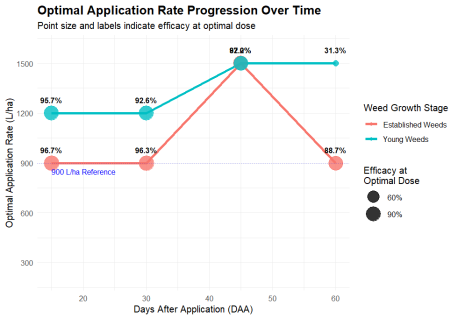
The progression of optimal application rates over time further highlights the critical difference in controllability between the two weed growth stages (
Figure 2). For
established weeds, the optimal dose remained at or below
900 L ha-1 for most of the trial, consistently delivering high efficacy (≥88.7%). This demonstrates a stable and efficient control profile. In stark contrast, the optimal dose for
young weeds was not only higher (≥1200 L ha
-1) but also provided rapidly diminishing returns. The efficacy at these high optimal doses collapsed from 95.7% at 15 DAA to a mere 31.3% by 60 DAA. This visualization highlights a key conclusion: while a moderate, cost-effective dose of bergamot juice provides sustained control of established weeds, even high doses offer only transient, albeit collapsing, control of young regrowth.
Figure 2. Temporal progression of optimal application rates and corresponding efficacy.
Optimal application rates and their corresponding efficacy over time for young and established weed communities, derived from quadratic regression models. Point size reflects the efficacy percentage at the optimal dose. The dashed line at 900 L ha-1 serves as a visual reference, highlighting its consistent performance for established weeds.
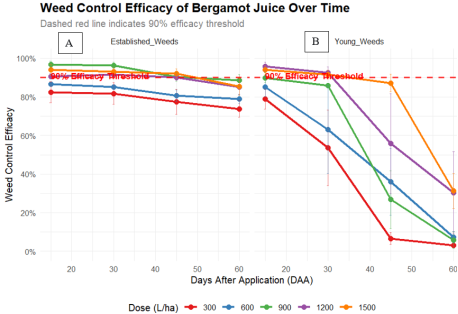
The progression of efficacy over the trial period is visualized in
Figure 3. For established weeds (
Figure 3A), the three highest doses (900, 1200, and 1500 L ha
-1) maintained efficacy above the 90% acceptability threshold for up to 45 days. In contrast, for young weeds (
Figure 3B), no treatment sustained acceptable control beyond 15 days, with all doses converging to very poor efficacy (≤ 31%) by the end of the trial.
Figure 3. Weed control efficacy of five application rates of bergamot juice over 60 days.
(A) Established weeds (four-month regrowth). (B) Young weeds (one-week regrowth). The dashed red line indicates the 90% efficacy threshold. Data points represent estimated marginal means from the mixed model.
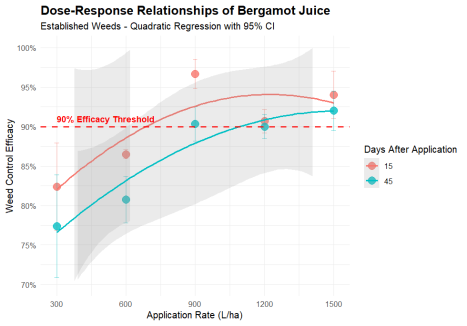
Furthermore, the dose-response relationship, analyzed through quadratic regression, revealed a distinct curvilinear pattern for established weeds at all time points (
Figure 4). The models consistently showed that efficacy increased with the application rate up to an optimum (the peak of the curve), after which it plateaued or slightly declined, explaining the high performance of the 900 L ha
-1 dose. The fit of these quadratic models was significant (p < 0.05 for all time points on established weeds), validating the use of this model for identifying optimal doses.
Figure 4. Dose-response relationships of bergamot juice on established weeds at different assessment dates.
Curves represent quadratic regression fits with 95% confidence intervals (shaded areas). The dotted horizontal line indicates the 90% efficacy threshold.
3.3. Efficacy Spectrum of Bergamot Juice
The herbicidal efficacy of bergamot juice varied considerably among weed species. At the first observation (15 DAA) on Site 1 (young weeds), most species present before treatment were controlled by the application. However, several taxa demonstrated tolerance or resistance (
Table 9). Three species from the
Poaceae family—
Paspalum dilatatum,
Digitaria sanguinalis, and
Panicum maximum - survived the treatment, as did
Centrosema pubescens (
Fabaceae) and
Talinum triangulare (
Talinaceae). The latter two species were only identified in plots treated with T4 (600 L ha
-1).
Table 9. Weed flora recorded before and after application of bergamot juice on the site of one week of weed regrowth (Site 1).
Species name | Family | Before Application | Day After Application (DAA) |
15 | 30 | 45 | 60 |
Paspalum dilatatum | Poaceae | X | X | X | X | X |
Centrosema pubescens | Fabaceae | X | X | X | X | X |
Panicum minimum | Poaceae | X | | | | |
Mimosa pudica | Fabaceae | X | | X | X | X |
Digitaria sanguinalis | Poaceae | X | X | X | X | X |
Arachis repens | Fabaceae | X | | | | |
Passiflora foetida | Passifloraceae | X | X | X | X | X |
Digitaria gayana | Poaceae | X | | | | |
Spigelia anthelmia | Loganiaceae | | | | X | X |
Euphorbia hirta | Euphorbiaceae | X | X | X | X | X |
Porophyllum ruderale | Asteraceae | X | | | | |
Schwenckia americana | Solanaceae | X | X | X | X | X |
Calopogonium mucunoides | Fabaceae | X | | X | X | X |
Gomphrena serrata | Amaranthaceae | X | | X | X | X |
Croton hirtus | Euphorbiaceae | X | X | X | X | X |
Euphorbia heterophylla | Euphorbiaceae | X | X | X | X | X |
Commelina benghalensis | Commelinaceae | X | X | X | X | X |
Boerhavia diffusa | Nyctaginaceae | X | | | | |
Talinum triangulare | Talinaceae | X | X | X | X | X |
Tridax procumbens | Asteraceae | | | | X | X |
Paederia foetida | Rubiaceae | X | | | | |
Panicum maximum | Poaceae | X | X | X | X | X |
'X’ indicates presence.
On Site 2 (established weeds), bergamot juice was effective against nearly all species present before treatment. A single species, Paspalum dilatatum (Poaceae), exhibited resistance across all treatment levels, although it displayed visible phytotoxic symptoms (leaf scorching).
The floristic inventory conducted at 60 DAA revealed a simplified weed flora comprising six species from three botanical families:
Poaceae,
Fabaceae, and
Phyllanthaceae. Plots receiving the highest application rate, T1 (1,500 L ha
-1), supported the least diverse weed community at the trial’s conclusion (
Table 10).
Table 10. Weed flora recorded before and after application of bergamot juice on the site of four months of weed regrowth (Site 2).
Species name | Family | Before Application | Day After Application (DAA) |
15 | 30 | 45 | 60 |
Phyllanthus amarus | Phyllanthaceae | X | X | X | X | X |
Paspalum dilatatum | Poaceae | X | X | X | X | X |
Centrosema pubescens | Fabaceae | X | X | X | X | X |
Panicum minimum | Poaceae | X | | X | X | X |
Mimosa pudica | Fabaceae | X | X | X | X | X |
Ageratum conyzoides | Asteraceae | X | | | | |
Digitaria sanguinalis | Poaceae | X | | | | X |
Chromolaena odorata | Asteraceae | X | | | | |
Digitaria gayana | Poaceae | X | | | | |
Porophyllum ruderale | Asteraceae | | | | | X |
Croton hirtus | Euphorbiaceae | | | | | X |
'X’ indicates presence.
Au In summary, bergamot juice appears to be less effective for controlling Paspalum dilatatum, Digitaria sanguinalis, Panicum maximum (Poaceae), Centrosema pubescens (Fabaceae), and Talinum triangulare (Talinaceae). Notably, Paspalum dilatatum was the only species identified as consistently resistant across all treatments on the site with established weeds (Site 2).
3.4. Persistence of Bergamot Juice
The residual activity, or persistence, of bergamot juice was assessed based on the duration of effective weed control. On Site 1 (young weeds), the two highest application rates (T1: 1,500 L ha-1 and T2: 1,200 L ha-1) provided effective control until 30 Days After Application (DAA). On Site 2 (established weeds), the three highest rates (T1, T2, and T3: 900 L ha-1) remained effective until 45 DAA. Based on these results, a minimum persistence of 30 days can be attributed to bergamot juice, defined as the period a phytosanitary product remains biologically active on the treated surface (US EPA, 2024).
However, the emergence of new seedlings was observed as early as 15 DAA on both sites, indicating that the treatment did not possess sufficient residual activity to prevent new germination. On Site 1, seedlings from nine species were recorded: Euphorbia heterophylla, E. hirta, Croton hirtus, Commelina benghalensis, Talinum triangulare, Digitaria sanguinalis, Passiflora foetida, Schwenckia americana, and Centrosema pubescens. On Site 2, seedlings of Centrosema pubescens, Mimosa pudica (Fabaceae), and Phyllanthus amarus (Phyllanthaceae) were observed.
This early regrowth can be attributed to significant rainfall events recorded during the trial period (
Table 1), particularly a 34.2 mm event on March 03 (16 DAA for Site 2). The persistence of organic herbicides, particularly those with water-soluble active ingredients, such as acetic acid, is known to be heavily influenced by precipitation, which can leach or dilute the product from the soil surface and the treatment zone
| [33] | US EPA (United States Environmental Protection Agency). (2024) Acetic acid, {(5-chloro-8-quinolinyl)oxy}-, 1-methylhexyl ester - Chemical Details | Chemical Search | Pesticides | US EPA. |
[33]
.
3.5. Effect of Bergamot Juice on Soil Acidity
Post-trial soil analysis revealed that the soil pH was acidic (pH < 7) across both experimental sites (
Table 11). On Site 2 (established weeds), no discernible differences in soil pH were observed between plots treated with bergamot juice and the untreated control plots. In contrast, on Site 1 (young weeds), plots treated with the three highest application rates (T1: 1,500 L ha
-1, T2: 1,200 L ha
-1, T3: 900 L ha
-1) exhibited a lower pH (pH < 5.0) compared to the control (pH 5.2) and the lower dose treatments T4 and T5 (pH ≥ 5.0).
Table 11. Soil pH results following the completion of the trials.
Treatments | Site 1 (One Week Regrowth) | Site 2 (Four Months Regrowth) |
pH | pH |
Tm (Control) | 5.2 | 5.4 |
T1 (1,500 L ha-1) | 4.8 | 5.4 |
T2 (1,200 L ha-1) | 4.4 | 5.5 |
T3 (900 L ha-1) | 4.3 | 5.5 |
T4 (600 L ha-1) | 5.0 | 5.5 |
T5 (300 L ha-1) | 5.1 | 5.5 |
The lack of a consistent dose-response relationship across sites, coupled with the fact that the most acidic value was not associated with the highest application rate, suggests that the observed pH differences on Site 1 are unlikely to be a direct effect of the bergamot juice application. Instead, they likely reflect pre-existing small-scale spatial heterogeneity in soil properties, a common feature in agricultural fields. This finding is consistent with the literature, which indicates that acetic acid, the primary active component, has a transient effect on soil pH and does not cause long-term acidification due to its rapid microbial degradation in soil.
4. Discussion
4.1. Efficacy of Bergamot Juice as a Bioherbicide
The efficacy of bergamot juice was highly dependent on the growth stage of the weeds at the time of application. On the site with one-week-old regrowth (Site 1), none of the treatments provided effective long-term control. The statistical models unequivocally demonstrate the inadequacy of bergamot juice for controlling young regrowth. Even the mathematically optimal high doses (1200-1500 L ha
-1) failed to sustain efficacy beyond 30 days, with the model predicting a collapse to below 35% control by 60 DAA (
Table 5,
Figure 3B). This reinforces the conclusion that the contact action of the primary active ingredient, acetic acid, functions by destroying the protective cuticular layer on plant leaves, leading to desiccation and cell death
. The recent mowing on this site left only small, immature regrowth and rigid, desiccated stem bases (tillers), which present a suboptimal surface for absorption compared to fully expanded leaf tissue. Consequently, the product was poorly absorbed, allowing for rapid weed regrowth from both surviving plant parts and seeds disturbed during the mowing process.
In contrast, on the site with established, four-month-old weeds (Site 2), the treatments T1 (1,500 L ha
-1) and T3 (900 L ha
-1) were effective. Our dose-response optimization analysis provides quantitative support for this finding, identifying 900 L ha
-1 as the optimal rate for initial and longer-term control (
Table 6,
Figure 3A). The fact that this intermediate dose performed as well as or better than the highest dose (1500 L ha
-1) suggests a potential non-linear relationship, where excessive volume may lead to runoff and reduced efficiency. This finding has critical implications for economic feasibility. The success of these higher application rates against mature weeds aligns with established principles for contact bioherbicides based on organic acids. This mode of action is shared by other natural herbicides, such as pelargonic acid and horticultural vinegar, which are also known to require high concentrations for effective burndown of established weeds
| [16] | Webber, C., Shrefler, J. and Brandenberger, L. (2012) Organic Weed Control. https://doi.org/10.5772/32539 |
| [34] | Matthews, G. A. (2018) A History of Pesticides. CABI. |
[16, 34]
. Research has shown that organic herbicides based on acids require higher concentrations to penetrate the thicker cuticles and larger biomass of older plants
| [34] | Matthews, G. A. (2018) A History of Pesticides. CABI. |
[34]
. The finding that T3 (900 L ha
-1) performed as well as, or slightly better than, T1 (1,500 L ha
-1) suggests a potential non-linear dose-response relationship. This could be explained by factors such as spray retention and coverage; a very high volume (T1) might lead to increased runoff, whereas an intermediate volume (T3) could provide optimal canopy coverage and retention on the leaf surface, thereby enhancing herbicidal activity. Alternatively, minor pre-existing spatial variations in weed species composition and density between the replicated plots could also account for this observed difference in mean efficacy.
The success of bergamot juice against mature weeds aligns with established principles for contact bioherbicides based on organic acids. Its mode of action, primarily via acetic acid, is similar to that of horticultural vinegar (which typically contains 10-20% acetic acid), which is known to be a potent desiccant. However, bergamot juice offers a distinct advantage as a readily available agricultural by-product. Furthermore, while other natural acid-based products like pelargonic acid (a fatty acid) are commercially available and provide rapid burndown, they often share the same limitation of limited residual activity and variable efficacy on grass species
| [16] | Webber, C., Shrefler, J. and Brandenberger, L. (2012) Organic Weed Control. https://doi.org/10.5772/32539 |
| [34] | Matthews, G. A. (2018) A History of Pesticides. CABI. |
[16, 34]
. Our results position bergamot juice as a viable, naturally-sourced alternative within this class of contact organic herbicides, with the added benefit of valorizing industrial waste.
4.2. Efficacy Spectrum of Bergamot Juice
The study revealed a distinct efficacy spectrum for bergamot juice, with several species demonstrating tolerance to it. Consistent poor control was observed for three grasses (Poaceae): Paspalum dilatatum, Digitaria sanguinalis, and Panicum maximum, as well as for Centrosema pubescens (Fabaceae) and Talinum triangulare (Talinaceae). Notably, Paspalum dilatatum was the only species that exhibited consistent resistance across all treatments on the site with established weeds (Site 2).
The variable efficacy among species can be attributed to several physiological and morphological factors. The inherent tolerance of particular grass species to contact, non-systemic herbicides like acetic acid is well-documented. This is a common limitation of organic acid herbicides, including pelargonic acid, which also often show variable performance on grass weeds due to similar protective morphological traits
. Grasses often possess a more vertical leaf orientation, a silica-rich epidermis, and a robust sheath surrounding the growing point (meristem), which can limit herbicide penetration and protect regrowth potential
. On Site 1 (young weeds), the recent mowing meant that species like
D. sanguinalis,
P. maximum,
C. pubescens, and
T. triangulare had not yet deployed substantial leaf area, minimizing the tissue surface available for herbicide contact and absorption.
The observation that bergamot juice controlled some
Poaceae species but not others underscores the concept of differential susceptibility within plant families. While acetic acid is registered for control of a broad range of weeds, including grasses
| [33] | US EPA (United States Environmental Protection Agency). (2024) Acetic acid, {(5-chloro-8-quinolinyl)oxy}-, 1-methylhexyl ester - Chemical Details | Chemical Search | Pesticides | US EPA. |
[33]
, its efficacy is not uniform across all species. The survival of
P. dilatatum,
D. sanguinalis, and
P. maximum suggests these species may possess specific traits—such as a thicker cuticle, more rapid regrowth from basal nodes, or an enhanced ability to metabolize the acid—that confer a higher level of tolerance compared to other, more susceptible grass and broadleaf species.
4.3. Persistence of Bergamot Juice
Based on the duration of effective control provided by the highest application rates, a minimum persistence of 30 days can be ascribed to bergamot juice. This is even though new seedling emergence was observed as early as 15 days after application (DAA) on both sites.
This early regrowth can be attributed to two primary factors. First, the removal of dominant weed species by the initial herbicide application can release resources (light, space, nutrients), facilitating the germination and establishment of other species from the soil seed bank, a well-documented ecological shift in managed ecosystems
. Second, the inherent lack of residual, pre-emergent activity in contact herbicides, such as those derived from bergamot juice, means they do not affect seeds that subsequently germinate.
The significant rainfall events recorded shortly after application on Site 2 (
Table 1) likely further curtailed any residual activity. The persistence of herbicides, particularly those with systemic or soil activity, is known to be influenced by environmental conditions, with precipitation being a key factor in their dissipation
. Given that acetic acid is highly soluble in water (US EPA, 2024), it is highly susceptible to being washed off from the soil surface and plant residues, or diluted in the soil moisture, thereby rapidly losing its efficacy and preventing any long-term residual control. This rapid dissipation under rainfall is a characteristic shared by many foliar-applied organic acid herbicides, limiting their residual activity compared to synthetic soil-residual compounds (US EPA, 2024).
4.4. Effect of Bergamot Juice on Soil Acidity
The post-trial soil analysis indicates that the application of bergamot juice did not induce a consistent or dose-dependent change in soil pH. The lower pH values recorded in some high-dose plots on Site 1 are unlikely to be a treatment effect, as this pattern was not observed on Site 2, and the most acidic value was not associated with the highest application rate. Instead, these variations are more plausibly explained by pre-existing small-scale spatial heterogeneity in soil properties, a common feature in agricultural landscapes.
Therefore, it can be concluded that a single application of bergamot juice, under the conditions of this trial, does not significantly alter soil pH. This finding aligns with the known behavior of short-chain organic acids like acetic acid in soil, where they undergo rapid microbial degradation to carbon dioxide and water, preventing a long-term accumulation of hydrogen ions that would cause acidification
| [37] | Jones, D. L., Dennis, P. G., Owen, A. G. and van Hees, P. A. W. (2003) Organic acid behavior in soils – misconceptions and knowledge gaps. Plant and Soil, 248, 31–41.
https://doi.org/10.1023/A:1022304332313 |
[37]
. This transient effect is a significant environmental advantage over some persistent synthetic herbicides and aligns with the safety profile of other commonly used organic acids in agriculture.
The statistical conclusions for the established weed site are highly reliable, as all model assumptions were met (Shapiro-Wilk p = 0.627; Levene’s p = 0.974). The minor violation of normality for the young weed data (Shapiro-Wilk p = 0.049) does not invalidate the clear and practically significant finding of the treatment’s ineffectiveness, which is visually obvious and supported by very high coefficients of variation.
5. Conclusion
This study demonstrates the significant potential of bergamot (Citrus bergamia) juice as a natural source for bioherbicide development. The results clearly indicate that the acetic acid contained in the juice has a potent suppressive effect on a broad spectrum of common weed species, but its utility is critically dependent on the target weed's growth stage. Key susceptible species included Phyllanthus amarus, Mimosa pudica, Ageratum conyzoides, Chromolaena odorata, and Digitaria gayana.
The efficacy was highly dependent on application rate and weed growth stage. The most consistent and effective control was achieved against established weeds with application rates of 1,500 L ha-1 and 900 L ha-1, which provided a minimum persistence of 30 days. In contrast, the bioherbicide was ineffective for sustained control of young weed regrowth. Furthermore, it showed limited efficacy against particular resilient species, most notably the grass Paspalum dilatatum. A critical finding is that a single application did not result in a significant or lasting alteration of soil pH, thereby mitigating a common concern associated with acid-based herbicides.
In conclusion, bergamot juice, often a by-product of the essential oil industry, represents a promising candidate for integrated and organic weed management strategies targeting established broadleaf weed infestations. To fully realize this potential, future research should focus on:
1) Optimizing application strategies (e.g., volume, adjuvants) to improve efficacy on tolerant grass species and potentially enhance cost-effectiveness.
2) Conducting a comprehensive economic analysis of the production and large-scale use of bergamot juice-based bioherbicide.
3) Undertaking more in-depth studies on its effects on soil chemical and biological properties beyond pH.
Abbreviations
ANOVA | Analysis of Variance |
CV | Coefficient of Variation |
DAA | Days After Application |
df | Degrees of Freedom |
EWRC | European Weed Research Council |
F-value | F-statistic Value |
HSD | Honest Significant Difference |
INP-HB | Félix Houphouët-Boigny National Polytechnic Institute |
L ha-1 | Liters per Hectare |
pH | Potential of Hydrogen |
p-value | Probability Value |
RCBD | Randomized Complete Block Design |
R² | Coefficient of Determination |
SAPT | Agricultural Sciences and Processing Techniques |
Tm | Treatment Control (Untreated Plot) |
T1–T5 | Treatment 1 Through Treatment 5 (Application rates) |
UMRI | Joint Research and Innovation Unit |
US EPA | United States Environmental Protection Agency |
Author Contributions
Eric-Olivier Tienebo: Conceptualization, Data curation, Formal Analysis, Investigation, methodology, software, Supervision, validation, visualization, Writing – original draft, Writing – review & editing
Desire Anicet Kouassi: Conceptualization, Data curation, methodology, Validation, Writing – original draft, Writing – review & editing
Alahou Andre Gabaze Gadji: Conceptualization, Investigation, Methodology, Validation, Writing – original draft, Writing – review & editing
Mienfoun Makoni Audrey Goueu: Conceptualization, Data curation, Investigation, Writing – original draft, Writing – review & editing
Wonhna Marc Soro: Project administration, Resources, Supervision, Validation, Visualization, Writing – review & editing
Kouassi Armand Ekra: Supervision, Validation, Visualization, Writing – review & editing
Massiata Dagnogo: Supervision, Validation, Writing – original draft, Writing – review & editing
Olga Droh: Project administration, Supervision, Validation, Writing – review & editing
Herve Kanga-Eba: Project administration, Resources, Supervision, Validation, Visualization, Writing – review & editing
Kouakou Theodore Kouadio: Supervision, Validation, Visualization, Writing – original draft, Writing – review & editing
Kouabenan Abo: Supervision, Validation, Visualization, Writing – original draft, Writing – review & editing
Conflicts of Interest
The authors declare no conflicts of interest.
References
| [1] |
Oerke, E.-C. (2006) Crop losses to pests. The Journal of Agricultural Science, 144, 31–43.
https://doi.org/10.1017/S0021859605005708
|
| [2] |
Zimdahl, R. L. (2018) Fundamentals of Weed Science. Academic Press.
|
| [3] |
Jabran, K. (2017) Allelopathy: Introduction and Concepts. In: Jabran K, editor. Manipulation of Allelopathic Crops for Weed Control, Springer International Publishing, Cham. p. 1–12.
https://doi.org/10.1007/978-3-319-53186-1_1
|
| [4] |
Rodenburg, J., Büchi, L. and Haggar, J. (2021) Adoption by adaptation: moving from Conservation Agriculture to conservation practices. International Journal of Agricultural Sustainability, 19, 437–55.
https://doi.org/10.1080/14735903.2020.1785734
|
| [5] |
Gianessi, L. P. (2013) The increasing importance of herbicides in worldwide crop production. Pest Management Science, 69, 1099–105.
https://doi.org/10.1002/ps.3598
|
| [6] |
Powles, S. B. and Yu, Q. (2010) Evolution in action: plants resistant to herbicides. Annual Review of Plant Biology, 61, 317–47.
https://doi.org/10.1146/annurev-arplant-042809-112119
|
| [7] |
Silva, V., Mol, H. G. J., Zomer, P., Tienstra, M., Ritsema, C. J. and Geissen, V. (2019) Pesticide residues in European agricultural soils – A hidden reality unfolded. Science of The Total Environment, 653, 1532–45.
https://doi.org/10.1016/j.scitotenv.2018.10.441
|
| [8] |
Kremer, R. J. and Kennedy, A. C. (1996) Rhizobacteria as Biocontrol Agents of Weeds. Weed Technology, 10, 601–9.
https://doi.org/10.1017/S0890037X00040525
|
| [9] |
Mathur, M. and Gehlot, P. (2018) Recruit the Plant Pathogen for Weed Management: Bioherbicide – A Sustainable Strategy. In: Gehlot P, and Singh J, editors. Fungi and Their Role in Sustainable Development: Current Perspectives, Springer, Singapore. p. 159–81.
https://doi.org/10.1007/978-981-13-0393-7_10
|
| [10] |
Cordeau, S., Triolet, M., Wayman, S., Steinberg, C. and Guillemin, J.-P. (2016) Bioherbicides: Dead in the water? A review of the existing products for integrated weed management. Crop Protection, 87, 44–9.
https://doi.org/10.1016/j.cropro.2016.04.016
|
| [11] |
Kudsk, P. and Mathiassen, S. K. (2004) Joint action of amino acid biosynthesis-inhibiting herbicides. Weed Research, 44, 313–22.
https://doi.org/10.1111/j.1365-3180.2004.00405.x
|
| [12] |
Kremer, R. J. (2005) The Role of Bioherbicides in Weed Management. Biopesticides International, 1, 127–41.
|
| [13] |
Bailey, K. L. (2014) The Bioherbicide Approach to Weed Control Using Plant Pathogens. Integrated Pest Management, Academic Press. p. 245–66.
https://doi.org/10.1016/B978-0-12-398529-3.00014-2
|
| [14] |
Hasan, M., Ahmad-Hamdani, M. S., Rosli, A. M. and Hamdan, H. (2021) Bioherbicides: An Eco-Friendly Tool for Sustainable Weed Management. Plants, 10, 1212.
https://doi.org/10.3390/plants10061212
|
| [15] |
Win, P.-P., Park, H.-H., Kuk, Y.-I., Win, P.-P., Park, H.-H. and Kuk, Y.-I. (2023) Control Efficacy of Natural Products on Broadleaf and Grass Weeds Using Various Application Methods. Agronomy, 13.
https://doi.org/10.3390/agronomy13092262
|
| [16] |
Webber, C., Shrefler, J. and Brandenberger, L. (2012) Organic Weed Control.
https://doi.org/10.5772/32539
|
| [17] |
IUSS Working Group WRB. (2022) World reference base for soil resources 2022: International soil classification system for naming soils and creating legends for soil maps. 4. edition. International Union of Soil Sciences, Vienna, Austria.
|
| [18] |
Birmingham, D. M. (2003) Local knowledge of soils: the case of contrast in Côte d’Ivoire. Geoderma, 111, 481–502.
https://doi.org/10.1016/S0016-7061(02)00278-1
|
| [19] |
Dayan, F. E., Cantrell, C. L. and Duke, S. O. (2009) Natural products in crop protection. Bioorganic & Medicinal Chemistry, 17, 4022–34.
https://doi.org/10.1016/j.bmc.2009.01.046
|
| [20] |
Dugo, G. and Bonaccorsi, I., editors. (2013) Citrus bergamia: Bergamot and its Derivatives. CRC Press, Boca Raton.
https://doi.org/10.1201/b15375
|
| [21] |
Gomez, K. A. and Gomez, A. A. (1984) Statistical Procedures for Agricultural Research. John Wiley & Sons.
|
| [22] |
Hutchinson, J. and Dalziel, J. M. (1954) Flora of West Tropical Africa: The British West African Territories, Liberia, the French and Portuguese Territories South of Latitude L8 ̊N. to Lake Chad, and Fernando Po. Crown Agents for Oversea Governments and Administrations.
|
| [23] |
Akobundu, I. O. and Agyakwa, C. W. (1987) A Handbook of West African Weeds. IITA.
|
| [24] |
Holm, L., Doll, J., Holm, E., Pancho, J. V. and Herberger, J. P. (1997) World Weeds: Natural Histories and Distribution. John Wiley & Sons.
|
| [25] |
Johnson, D. E. (1997) Weeds in rice cultivation in West Africa. Association for the Development of Rice Cultivation in West Africa.
|
| [26] |
Booth, B. D., Murphy, S. D. and Swanton, C. J. (2010) Invasive Plant Ecology in Natural and Agricultural Systems. CABI.
|
| [27] |
Kropff, M. J. and Spitters, C. J. T. (1991) A simple model of crop loss by weed competition from early observations on relative leaf area of the weeds. Weed Research, 31, 97–105.
https://doi.org/10.1111/j.1365-3180.1991.tb01748.x
|
| [28] |
EWRC (European Weed Research Council). (1964) Report of the Third and Fourth Meetings of the European Weed Research Council Committee on Methods. Weed Research, 4, 79–79.
https://doi.org/10.1111/j.1365-3180.1964.tb00271.x
|
| [29] |
Sparks, D. L., Page, A. L., Helmke, P. A. and Loeppert, R. H. (2018) Methods of Soil Analysis, Part 3: Chemical Methods. Wiley & Sons, Limited, John.
|
| [30] |
Searle, S. R., Speed, F. M. and Milliken, G. A. (1980) Population Marginal Means in the Linear Model: An Alternative to Least Squares Means. The American Statistician, 34, 216–21.
https://doi.org/10.1080/00031305.1980.10483031
|
| [31] |
Lenth, R. V. and Piaskowski, J. (2017) emmeans: Estimated Marginal Means, aka Least-Squares Means [Internet]. p. 2.0.0.
https://doi.org/10.32614/CRAN.package.emmeans
|
| [32] |
Wickham, H. (2016) ggplot2: Elegant Graphics for Data Analysis. 2nd ed. Springer Publishing Company, Incorporated.
|
| [33] |
US EPA (United States Environmental Protection Agency). (2024) Acetic acid, {(5-chloro-8-quinolinyl)oxy}-, 1-methylhexyl ester - Chemical Details | Chemical Search | Pesticides | US EPA.
|
| [34] |
Matthews, G. A. (2018) A History of Pesticides. CABI.
|
| [35] |
Booth, B. D. and Swanton, C. J. (2002) Assembly theory applied to weed communities. Weed Science, 50, 2–13.
https://doi.org/10.1614/0043-1745(2002)050%255B0002:AIATAT%255D2.0.CO;2
|
| [36] |
Weber, J. B., Wilkerson, G. G. and Reinhardt, C. F. (2004) Calculating pesticide sorption coefficients (Kd) using selected soil properties. Chemosphere, 55, 157–66.
https://doi.org/10.1016/j.chemosphere.2003.10.049
|
| [37] |
Jones, D. L., Dennis, P. G., Owen, A. G. and van Hees, P. A. W. (2003) Organic acid behavior in soils – misconceptions and knowledge gaps. Plant and Soil, 248, 31–41.
https://doi.org/10.1023/A:1022304332313
|
Cite This Article
-
APA Style
Tienebo, E., Kouassi, D. A., Gadji, A. A. G., Goueu, M. M. A., Soro, W. M., et al. (2025). Dose-response of Bergamot Juice as a Post-emergence Bioherbicide on Young and Established Weed Regrowth Under Field Conditions in South-western Cote d'Ivoire. American Journal of BioScience, 13(6), 218-233. https://doi.org/10.11648/j.ajbio.20251306.14
 Copy
|
Copy
|
 Download
ACS Style
Tienebo, E.; Kouassi, D. A.; Gadji, A. A. G.; Goueu, M. M. A.; Soro, W. M., et al. Dose-response of Bergamot Juice as a Post-emergence Bioherbicide on Young and Established Weed Regrowth Under Field Conditions in South-western Cote d'Ivoire. Am. J. BioScience 2025, 13(6), 218-233. doi: 10.11648/j.ajbio.20251306.14
Copy
|
Download
AMA Style
Tienebo E, Kouassi DA, Gadji AAG, Goueu MMA, Soro WM, et al. Dose-response of Bergamot Juice as a Post-emergence Bioherbicide on Young and Established Weed Regrowth Under Field Conditions in South-western Cote d'Ivoire. Am J BioScience. 2025;13(6):218-233. doi: 10.11648/j.ajbio.20251306.14
Copy
|
Download
-
@article{10.11648/j.ajbio.20251306.14,
  author = {Eric-Olivier Tienebo and Desire Anicet Kouassi and Alahou Andre Gabaze Gadji and Mienfoun Makoni Audrey Goueu and Wonhna Marc Soro and Kouassi Armand Ekra and Massiata Dagnogo and Olga Droh and Herve Kanga-Eba and Kouakou Theodore Kouadio and Kouabenan Abo},
  title = {Dose-response of Bergamot Juice as a Post-emergence Bioherbicide on Young and Established Weed Regrowth Under Field Conditions in South-western Cote d'Ivoire},
  journal = {American Journal of BioScience},
  volume = {13},
  number = {6},
  pages = {218-233},
  doi = {10.11648/j.ajbio.20251306.14},
  url = {https://doi.org/10.11648/j.ajbio.20251306.14},
  eprint = {https://article.sciencepublishinggroup.com/pdf/10.11648.j.ajbio.20251306.14},
  abstract = {The search for effective and environmentally sustainable bioherbicides is a key objective in integrated weed management. This study evaluated the herbicidal potential of bergamot (Citrus bergamia) juice, a by-product of the essential oil industry, based on its high acetic acid content. Field experiments were conducted using a randomized complete block design to test five application rates (1,500, 1,200, 900, 600, and 300 L ha-1) on two contrasting weed communities: young regrowth (one week after mowing) and established weeds (four months after mowing). Efficacy was assessed over 60 days using the Henderson-Tilton formula and the European Weed Research Council (EWRC) rating scale. Soil pH was analyzed post-trial to detect acidification. A central finding was the stark contrast in efficacy based on weed growth stage. On established weeds, the rates of 1,500 L ha-1 and 900 L ha-1 provided the best control, with a residual activity of 30-45 days and efficacy >90% for up to 45 Days After Application (DAA). In sharp contrast, the treatment was largely ineffective on young regrowth, with even the highest doses providing only transient control that declined to very poor efficacy (≤31%) by 60 DAA. Results demonstrated that bergamot juice provided effective control of a broad spectrum of broadleaf weeds, including Phyllanthus amarus and Ageratum conyzoides, but showed poor efficacy against several grass species, particularly Paspalum dilatatum. Critically, no significant or consistent changes in soil pH were detected following application. The findings confirm that bergamot juice is a viable contact bioherbicide for managing established broadleaf weeds without impacting soil acidity but is not suitable for controlling young regrowth. Further research is needed to optimize application strategies, determine its economic feasibility, and fully elucidate its efficacy spectrum for commercial adoption.},
 year = {2025}
}
Copy
|
Download
-
TY  - JOUR
T1  - Dose-response of Bergamot Juice as a Post-emergence Bioherbicide on Young and Established Weed Regrowth Under Field Conditions in South-western Cote d'Ivoire
AU  - Eric-Olivier Tienebo
AU  - Desire Anicet Kouassi
AU  - Alahou Andre Gabaze Gadji
AU  - Mienfoun Makoni Audrey Goueu
AU  - Wonhna Marc Soro
AU  - Kouassi Armand Ekra
AU  - Massiata Dagnogo
AU  - Olga Droh
AU  - Herve Kanga-Eba
AU  - Kouakou Theodore Kouadio
AU  - Kouabenan Abo
Y1  - 2025/12/29
PY  - 2025
N1  - https://doi.org/10.11648/j.ajbio.20251306.14
DO  - 10.11648/j.ajbio.20251306.14
T2  - American Journal of BioScience
JF  - American Journal of BioScience
JO  - American Journal of BioScience
SP  - 218
EP  - 233
PB  - Science Publishing Group
SN  - 2330-0167
UR  - https://doi.org/10.11648/j.ajbio.20251306.14
AB  - The search for effective and environmentally sustainable bioherbicides is a key objective in integrated weed management. This study evaluated the herbicidal potential of bergamot (Citrus bergamia) juice, a by-product of the essential oil industry, based on its high acetic acid content. Field experiments were conducted using a randomized complete block design to test five application rates (1,500, 1,200, 900, 600, and 300 L ha-1) on two contrasting weed communities: young regrowth (one week after mowing) and established weeds (four months after mowing). Efficacy was assessed over 60 days using the Henderson-Tilton formula and the European Weed Research Council (EWRC) rating scale. Soil pH was analyzed post-trial to detect acidification. A central finding was the stark contrast in efficacy based on weed growth stage. On established weeds, the rates of 1,500 L ha-1 and 900 L ha-1 provided the best control, with a residual activity of 30-45 days and efficacy >90% for up to 45 Days After Application (DAA). In sharp contrast, the treatment was largely ineffective on young regrowth, with even the highest doses providing only transient control that declined to very poor efficacy (≤31%) by 60 DAA. Results demonstrated that bergamot juice provided effective control of a broad spectrum of broadleaf weeds, including Phyllanthus amarus and Ageratum conyzoides, but showed poor efficacy against several grass species, particularly Paspalum dilatatum. Critically, no significant or consistent changes in soil pH were detected following application. The findings confirm that bergamot juice is a viable contact bioherbicide for managing established broadleaf weeds without impacting soil acidity but is not suitable for controlling young regrowth. Further research is needed to optimize application strategies, determine its economic feasibility, and fully elucidate its efficacy spectrum for commercial adoption.
VL  - 13
IS  - 6
ER  -
Copy
|
Download

 ,
Desire Anicet Kouassi
,
Desire Anicet Kouassi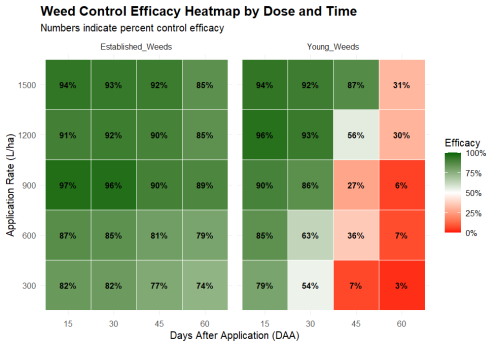



 Share This Article
 Twitter
 Linked In
 Facebook